Edoardo Villa
b.1915, Bergamo; d.2011, Johannesburg
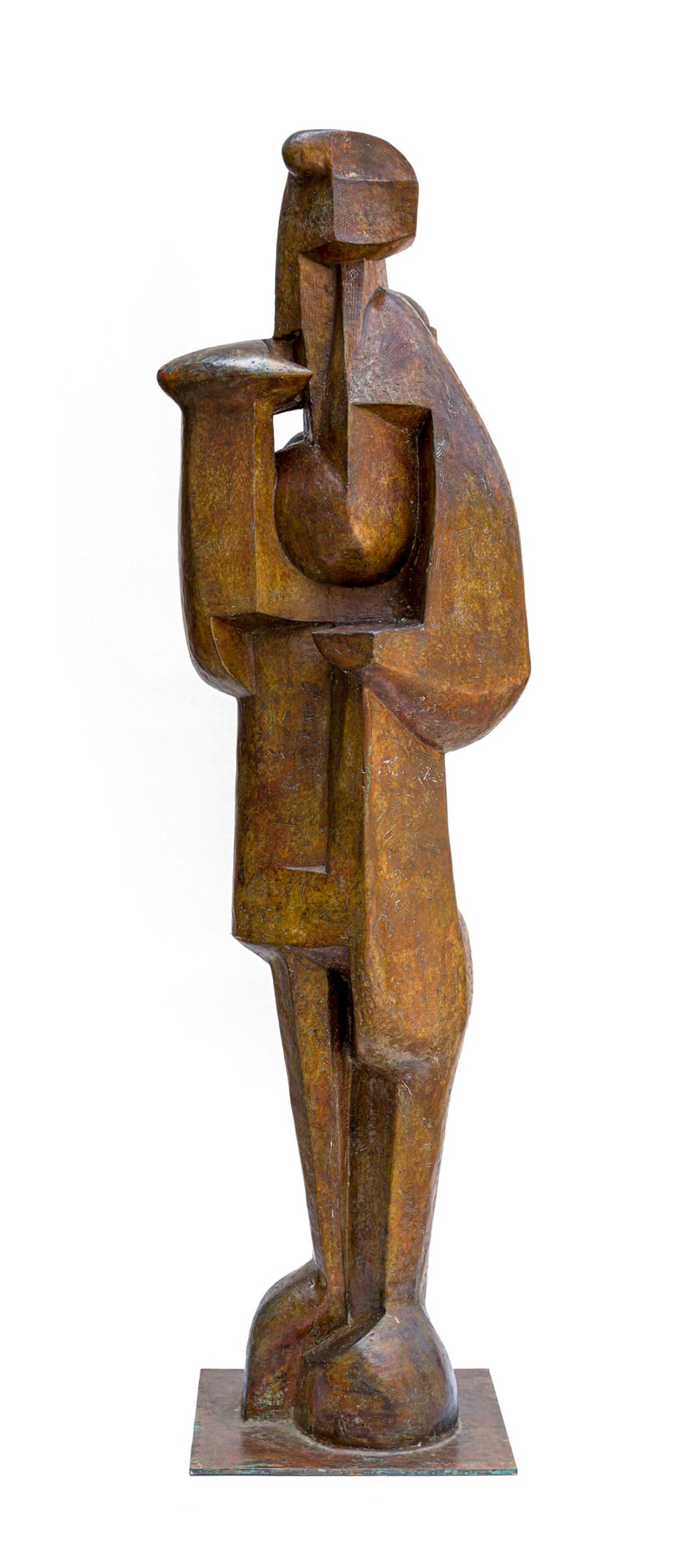
Native son of Bergamo, Italy, Edoardo Villa was not at first destined to become one of South Africa’s leading modernist sculptors. His unlikely journey began as a young man when he was conscripted to serve in the Second World War in 1939. Sent to North Africa, he was captured by British troops and transferred to a POW camp at Zonderwater in the Transvaal, where he served a four-year sentence. Villa stayed on following his release, preferring the ‘open space’ of the Highveld to the ‘closed life’ of continental Europe. “Everything in Europe I felt had been done, questioned and exhausted,” the artist later said. “Here, in Africa, I felt I had the opportunity to explore.” Villa’s formal grammar was the meeting of two languages, an expression of European modernism in a South African idiom. His work, art historian Esmé Berman wrote, spoke “not of the appearance but of the experience of Africa.” Over the many decades of his prolific career, he moved progressively away from figuration and bronze modelling to purely abstract compositions made with industrial steel. Many of these brightly coloured monumental works still mark the South African landscape as public sculptures, just as the country’s landscape first marked his practice.
In addition to his sculptural legacy, Villa is remembered for his contributions as a mentor at the Polly Street Art Centre in Johannesburg during the 1950s, and as a founding member of the Amadlozi Group, which championed the pursuit of a singularly South African aesthetic.